Summary
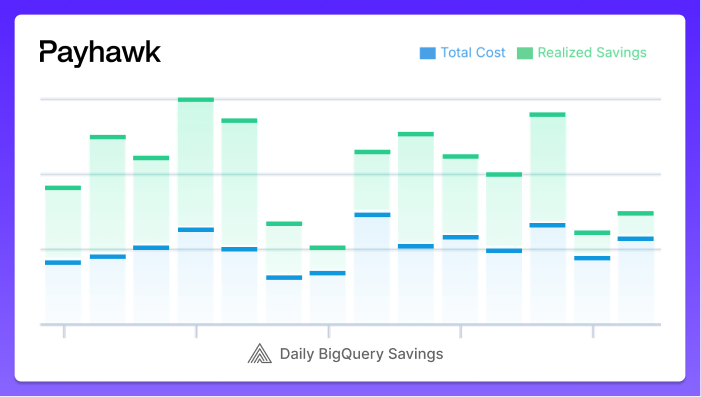
Payhawk is a leading spend management platform, combining company cards, expenses, accounts payable and procurement for mid-market and enterprise businesses in more than 32 countries. Its analytics run on BigQuery, with Dataform workflows transforming data and Tableau dashboards serving teams across the business. By partnering with Alvin, Payhawk moved from running everything on on-demand pricing to an automatically managed mix of Standard edition and on-demand. The result is a 50% reduction in BigQuery compute spend, with no changes to its dashboards or data models.
The Challenge
Payhawk ran all of its BigQuery workloads on on-demand pricing. It was simple to operate, but every query was billed per byte scanned, whether or not that was the cheapest way to run it.
Payhawk's workloads are heterogeneous. Dataform workflows transform data on a schedule, while Tableau sends a steady stream of queries as people open dashboards, refresh extracts and filter reports. Some of those queries scan large volumes of data with light processing, which makes them expensive on on-demand pricing. Others are compute-heavy, and would cost more and could run slower on a reservation.
That left no single right answer. Staying fully on-demand meant overpaying for scan-heavy work, while moving everything onto a reservation would have made compute-heavy queries more expensive. Splitting workloads by hand would have meant constant analysis and reconfiguration as usage changed, an effort the data team couldn't justify.
The Solution
Payhawk deployed Alvin's autonomous optimization agent to manage the billing model for its BigQuery workloads. Rather than picking one pricing model for everything, Alvin introduced a mix of Standard edition capacity and on-demand pricing, and decides continuously which workloads belong where.
- Workload-Aware Billing Optimization: Alvin analyzes the cost profile of each workload against its historical slot usage and bytes processed. Scan-heavy work runs on Standard edition capacity, while compute-heavy work stays on on-demand pricing.
- Continuous Re-evaluation: As Tableau usage and Dataform pipelines change, Alvin adjusts placement automatically, so savings hold as the business grows.
- Zero Engineering Overhead: Alvin runs autonomously, with no changes to Tableau dashboards, Dataform code or SQL, and no manual capacity planning.
The Results
- 50% reduction in BigQuery compute spend.
- The best of both billing models, with Standard edition and on-demand pricing each handling the workloads they suit.
- No changes to dashboards or data models, with Tableau and Dataform running exactly as before.
- Zero maintenance overhead, freeing the data team from billing decisions and capacity planning.
- Guaranteed positive ROI through Alvin's performance-based, "no cure, no pay" pricing.
"We’ve cut our BigQuery compute spend in half without changing a single dashboard or data model. The Alvin team is great to work with, and the whole setup took just one introductory call and a few messages back and forth."
Todor Dimovski, Business Intelligence Manager at Payhawk
Billing Model Optimization
On-demand pricing charges for bytes scanned, while Standard edition charges for compute capacity. Which one is cheaper depends on the query. A Tableau dashboard scanning a large table with simple aggregations can cost far more on-demand than on capacity, while a complex Dataform transformation can be cheaper on-demand.
Alvin evaluates the cost profile of Payhawk's workloads and places each on the billing model where it costs least. Scan-heavy queries run on Standard edition capacity, avoiding per-byte charges. Slot-intensive queries stay on on-demand pricing, where paying for bytes scanned costs less than paying for slots.
Optimization for BI and Transformation Workloads
Tableau and Dataform make up the bulk of Payhawk's BigQuery usage, and they behave very differently. Dataform runs on a predictable schedule, while Tableau traffic follows people, arriving in bursts as teams open dashboards and refresh data throughout the day.
Alvin optimizes both without touching either tool. Analysts keep using Tableau exactly as before, engineers keep shipping Dataform models as before, and Alvin re-evaluates placement as usage shifts, so new dashboards and pipelines are optimized from the moment they start running.